
VANN EQUITY MANAGEMENT
VANN EQUITY MANAGEMENT
Financial Market
Insights
Highlights
Initial Thoughts on the Iranian Strikes on Israel
Weekly Market Preview: How Bad Was Last Week for the Rally
Special Reports and Editorial:
The Most Important Long-Term Indicator for Markets
What Does CPI Mean for Markets?

Stocks
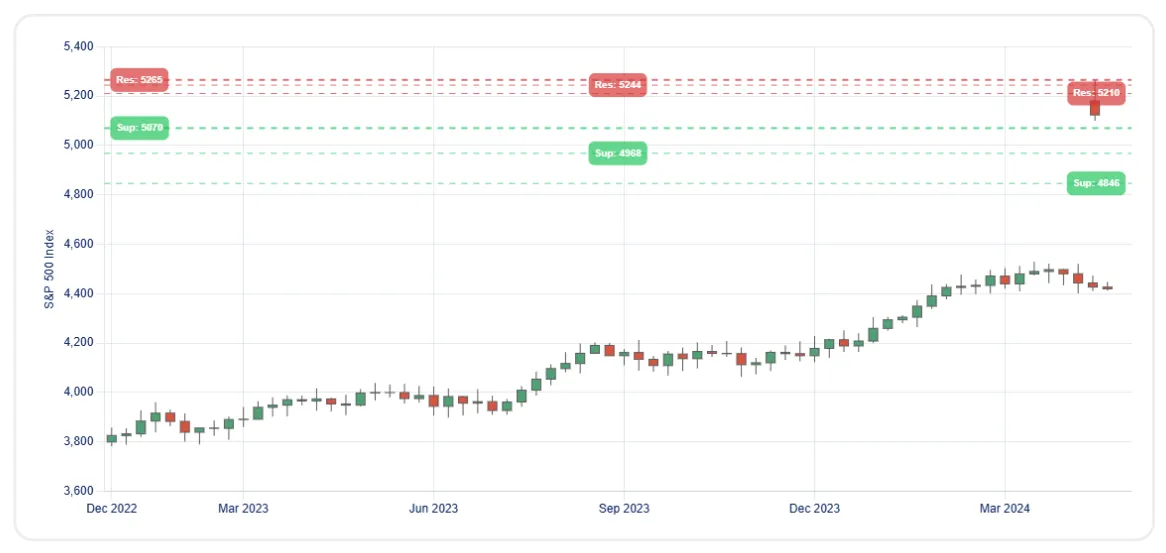
The S&P 500 declined last week as June rate cut expectations plunged following the hotter-than-expected CPI report and as Treasury yields surged to multi-month highs.
What is Outperforming: Growth factors, tech, consumer discretionary and communication services have outperformed thanks to strong earnings and continued "Al" enthusiasm.
What is Underperforming: Defensive sectors and value have underperformed recently mostly as Treasury yields have risen, although they are poised to rebound substantially if there is a surprise slowing of growth.
Initial Thoughts on the Iranian Strikes on Israel?
Geopolitical tensions rose even further over the weekend as Iran launched several hundred missiles and drones at Israel, reflecting the biggest increase in tensions in the Middle East in decades. The immediate impact on markets would be as we would expect given rising geopolitical risks: Higher oil prices, lower stocks, higher risk-off assets (e.g., Treasuries). In the short term, the weekend's events can be filed under the "Things We Do Not Need Right Now" category, as a market that has had a quasi-perfect environment for nearly five months must now contend with several disappointments including a hot CPI that pushes back on the idea of declining inflation, reduced Fed rate cut expectations from June to September (which means higher rates for longer) and a dramatic escalation in geopolitical tensions. That will increase volatility in the near term.
However, there is reason to believe that geopolitical tensions will not become a material negative for markets. First, the Iranian attack on Israel was largely ineffective, as the vast majority of drones and missiles were intercepted by Israeli and U.S. forces. Second, Iranian officials declared after the launches the matter was "concluded," hinting they did not want further conflict. Third, the U.S. has said it will not support any offensive action by Israel against Iran, reducing the chances of a material, retaliatory strike from the Israelis.
The Bottom Line
This is clearly a further deterioration in the geopolitical landscape, and it will increase market volatility. However, we would be hesitant to extrapolate this out to a bearish game-changing event. Yes, tensions remain high and the chances of a broader conflict in the region are present, but there remains a path to de-escalation. From a market standpoint, our investment team views this as making a pullback towards 5,000 in the S&P 500 more likely but does not view it as a fundamental negative shift that requires materially more defensive positioning for anyone other than a very short-term trader.
How Bad Was Last Week for the Rally?
The S&P 500 dropped to a one-month low and experienced the strongest selling we have seen since the first two weeks of the year as inflation ran hot, markets abandoned the idea of a June rate cut and the two ongoing geopolitical crises (Russia/Ukraine and Israel/Gaza) threatened to escalate.
Looking at the events of last week, there were some clear negatives, and the market reaction was legitimate. First, CPI showed the decline in inflation, which had slowed to a crawl in recent months, fully stalled and that challenged the idea of falling inflation which has been one of the keys to this rally. Second, rate cut expectations for June were dramatically reduced and the first rate cut is now expected in September. That challenged the idea of looming rate cuts, which had also been one of the keys to this rally. Nevertheless, were these events material negatives that should make us suspect of this rally? No, not at this point.
As we have said, the key impact of the stall in declining inflation and delayed rate cuts is that it shattered the unrealistically optimistic view/valuation, but it did not change the medium-term outlook. Put in more regular terms, our investment team and others have called this a "Teflon" market, in that no bad news would "stick" and stop the rally. Well, last week, the hot CPI delayed Fed rate cuts and geopolitical tension "stuck" and stocks dropped accordingly.
However, there is a difference between not perfect and bad, and that is the key takeaway from last week. Inflation has stopped falling (not perfect) but it is not rebounding (that would be very bad). The Fed will not cut in June (not perfect), but the Fed is not thinking about hiking rates (that would be very bad).
The Bottom Line
The market was priced for perfection at 5,200 in the S&P 500 but it was forcefully reminded this week that the environment is not perfect, and stocks are declining accordingly. Given that sentiment and positioning were extended on the bullish side of the ledger, a continued decline towards 5,000 should not shock anyone. Unless we see more bullish factors deteriorate (meaning growth underwhelms or Al enthusiasm begins to disappoint) or the Fed talks about hikes or inflation rebounds, then any decline towards (or through) 5,000 in the S&P 500 is likely an opportunity to add long exposure at more reasonable valuations. Bottom line: Last week's news was bad, but the four parts of this rally remain largely intact (solid growth, inflation declining, Fed cutting rates and Al enthusiasm) and it will take further deterioration to challenge the validity of the rally (although again, a further pullback near term should not surprise anyone).
ECONOMIC DATA & COMMODITIES
Economic Data (What You Need to Know in Plain English)
Fed rate cuts, falling inflation, and a Republican sweep are probably good for stock prices and the economy; however, they are not guaranteed good (and they could, in fact, be bad). Moreover, the market at these levels is ignoring the possibility these events are not positive. Our investment committee does not want to ignore these possibilities when we are thinking about current exposure, levels, etc. So, we are pointing them out here to make sure we keep ourselves grounded amidst this bubbling market euphoria.
Clearly the momentum in markets is higher and this is, currently, a Goldilocks environment for stocks. Yet the market continues to reek of complacency regarding some very substantial changes in macroeconomic forces compared to the past several years, and while our investment team sincerely hopes they all work out positively, we must acknowledge the downside of these events as well, because we will not get blindsided (as some advisors and investors will be) should one (or more) of these events not be as positive as currently expected.
CPI was the key report so far this month and it beat expectations, further signaling disinflation is ongoing and, most importantly, likely solidified the Fed will cut rates in September and kick off a rate cutting campaign.
The focus will turn to growth this week and while none of the data is from the major monthly reports, all growth data matters (especially given the Fed is about to start cutting rates) so that we can learn, as early as possible, if rate cuts will be enough to prevent a stall or contraction in the economy. Put simply, the chorus of economic data that has been pointing to a loss of momentum has grown louder over the past month and if that continues, growth concerns will creep higher.
The most important economic report this week is Wednesday’s June Retail Sales. The U.S. economy is a consumer-driven economy and put simply, if the consumer pulls back, the chances of a hard landing will rise. Retail spending has been, at best, plateauing lately and if that plateau turns into an outright decline or contraction, it will be an incremental negative for markets.
The next most important report will be the Empire Manufacturing Index and the Philly Fed Survey. These are the first data points of every month so they will give us the first look at July activity. Now, these metrics have been volatile, to put it generously, but they still matter in a broad sense of are they getting better, worse or about the same? Both have been largely about the same, showing a modest contraction in manufacturing in both regions in recent months and if that gets better, it is a mild positive. If it gets worse, it is a negative.
The Bottom Line
Growth has mattered all year and with the Fed rate cuts now known, it matters even more because it brings us closer to answering the question: “Did they cut in time?”—and the data will tell us.
Commodities, Currencies & Bonds
Commodities declined modestly last week despite a weaker U.S. Dollar, as global growth worries weighed on oil while gold saw a modest rally thanks to the lower dollar.
Gold was little changed through the front half of the week before lurching towards record highs on Thursday thanks to the cool June CPI data and the resulting combination of firming Fed rate cut expectations for the months ahead and rising confidence in the economy achieving a soft economic landing this year.
The Dollar Index declined again last week following the better-than-expected CPL report, as markets more fully priced in two rate cuts in 2024.
The better-than-expected CPI report was the main catalyst for markets last week and the result was as you would expect: A weaker dollar and lower Treasury yields.
For now, falling rates remain positive for stocks but as we and others keep saying, falling yields will only stay positive for stocks until a certain point (Our team pegs that around 3.75%, but it could be a bit higher or lower). However, if the 10-year yield falls towards and through 4.00%, that will be a clear signal from investors they are getting more worried about growth—and at that point, falling yields will transition to a negative signal. So, the more the 10-year Treasury yield is stable between 4.00%-4.25%, the better for stocks.
Treasury yields declined moderately last week as the smaller than expected increase in CPI pressured yields, and the 10-year fell back into the 3.75% - 4.25% ‘stock positive’ range.
Special Reports and Editorial
Is the Rotation from Tech to the “Rest of the Market” Sustainable?
By far the biggest impact of last week’s CPI report was the massive rotation out of tech and tech-related sectors (tech, consumer discretionary, communication services) and into sectors that are 1) More sensitive to lower rates and 2) Cyclical in nature. This is best exemplified by the fact that the Russell 2000 surged almost 3.6% Thursday while the Nasdaq 100 dropped 2%, resulting in a massive 6% swing in their relative performance. But even considering that massive 6% swing, the Nasdaq is still outperforming the Russell 2000 by 15% YTD and that just underscores how badly cyclical and lower-rate-sensitive sectors have performed compared to AI-driven tech.
Further evidence of this rotation can be seen in the sector trading, as the only sectors to decline meaningfully were tech, consumer discretionary, and communication services (all tech and AI-related sectors). Consumer staples (XLP) declined 0.55% but that was because of disappointing earnings from Pepsi (PEP) and Conagra (CAG).
Every other sector in the S&P 500 traded solidly higher, led by real estate (XLRE) and utilities (XLU), which gained 2.7% and 1.8%, respectively. The reason for the rallies was clear: Those sectors have large dividends and stand to benefit if rates are now on a sustainable path lower. Similarly, small caps (IWM) also benefit from lower rates (again the Russell 2000 rose 3.6%). Other sectors that were higher included: materials (XLB up 1.4%), industrials (XLI up 1.3%), and energy (XLE up 1.3%). Those sectors are all cyclical, in that they do well when economic growth is accelerating, and, for Thursday at least, investors embraced the idea that a sustainable decline in rates will lead to more resilient growth and cyclical can do well.
So, can the sectors that led markets Thursday continue to outperform? In the near term, yes. The performance gap between tech and the rest of the market is so wide that it is reasonable to expect continued closing of that gap as markets more fully embrace the idea of the start of a rate-cutting cycle.
However, for this rotation to be sustainable beyond just a few weeks (and instead into the fourth quarter and end of the year) economic growth must remain resilient and we cannot have a growth scare. If we do have a growth scare, then cyclical sectors such as energy, industrials, materials, and financials will likely not do well (although defensive sectors such as utilities/REITs/staples and healthcare should relatively outperform).
So, whether one thinks this rotation and the “rest” of market outperformance can continue depends on one’s opinion on growth.
Because our investment team is more concerned about growth than the consensus, we are not inclined to think this cyclical/rest-of-market outperformance can continue and as such, we are not chasing value/cyclicals here.
Powell Testimony Takeaways
Fed Chair Powell testified before congress last week and there were two notable takeaways from his comments. First, Powell continued to say that all the Fed needs is some more “good” inflation data to be in a position to cut rates. That is dovish on its face, but it is also the same thing he has been saying for the past month-plus, and since a September rate cut currently has an 80% expectation from the market, that comment merely reinforced what is now widely expected, and as such it did not really move markets.
Second, if you read between the lines of Powell’s comments, it is clear the Fed is focusing on slowing growth, while the market still is not. Powell made several small comments to reflect this reality, including some comments on cooling in the labor market and again referring that risks to the outlook are balanced between inflation and growth. Yet perhaps the most notable comment was that inflation, “is not the only risk we face.”
We view Powell’s commentary as reinforcing our concern that the market is complacent to growth risks. That does not mean we are predicting a recession because we are not; however, we do think the chances of a growth scare continue to rise, and at this point, there is a growing disconnect between what the Fed is worried about (growth) and what the market is worried about (nothing, other than AI earnings).
Market Multiple Table: An Important Change
For much of 2024, the S&P 500 has been trading solidly above any fundamental justified valuations, as a combination of rate cut hopes and AI earnings pushed the S&P 500 to the very limits of forward valuations. But the “market multiple” math just got a bit easier for the bulls, because around July of each year, analysts switch their earnings expectations from the current year to the next year, and in doing so the July Market Multiple Table now shows this market, at these levels, is reasonably valued as long as 2025 earnings estimates are correct!
To be more specific, consensus S&P 500 earnings for 2025 are around $270/share, solidly higher than the $243 estimate for 2024. And while this upcoming earnings season can change those numbers, for now, they are intact and as a result, the “fair value” of the S&P 500 using next year’s earnings has now leaped to the mid-5,000 range.
Importantly, this is not just a bookkeeping formality. Analysts value the market based on next year’s earnings and “next year” is now (or soon will be) 2025 earnings and based on those metrics, while the market is not cheap, it is no longer wildly above fundamental valuations (as it was before).
This change impacts investors in two ways. First, it does not remove the risk of a correction or pullback. Markets are still aggressively optimistic about a soft landing, aggressive Fed rate cuts, and resilient earnings. The net result is a high multiple (still around 20X). If growth slows more than expected or earnings fall, this market will drop.
Second, this earnings shift does make the YTD gains “stickier” in the event of a mild pullback. Put differently, current S&P 500 levels are a lot more justifiable using 2025 EPS (which is legitimate now). So, it is going to take real, negative news to cause a meaningful pullback in stocks (like a growth scare, fewer Fed rate cuts, geopolitical surprises, or AI disappointment).
The Bottom Line
The stock market has been trading at very aggressive valuations for much of 2024 and the change in earnings makes current market levels more justifiable. Additionally, it opens a credible path to another 5%-10% rally. However, the facts have not changed regarding the risks facing this market, and if there is legitimate negative news on one of the four market influences, a drop of 5% is possible. If there is a negative turn in multiple market influences, a drop of 10% or more is not just possible, it is likely.
Current Situation
Growth is slowing but not too slow and a soft landing is still expected, Markets widely expect the Fed to cut in September and twice in 2024, AI enthusiasm remains high, and geopolitical risks have eased slightly over the past month. The current situation reflects an environment that is still broadly supportive of stocks (and deserves a high multiple), but it is also leaving investors extremely vulnerable to a growth scare given that high multiple and recently soft economic data. And while the outlook for stocks is positive this market is still very aggressively valued given the current macroeconomic reality and at risk of a sudden, sharp pullback.
Things Get Better If
Economic data stabilizes, the Fed confirms a September rate cut, AI tech companies continue to beat earnings, and geopolitical risks decline. This would reflect a “perfect” environment for stocks of 1) Solid economic growth (so no slowdown), 2) Continued upward pressure on earnings expectations thanks to AI stocks, 3) Near-term rate cuts, and 4) Declining geopolitical risks. This environment could justify a 22X multiple in the markets (and 21X at least), which means “fair value” for the S&P 500 in this scenario is in the upper 5,000s.
Things Get Worse If
Economic data gets worse and points to a slowdown, AI-related tech companies miss earnings, the Fed pushes back on a September rate cut and geopolitical risks rise. This scenario would essentially undermine the assumptions behind much of the October-present rally and a giveback of much of the October-to-present rally would not be out of the question (that means a decline into the low 4,000s in the S&P). And while it seems like this outcome is not possible given still-elevated valuations, none of this is set in stone and this is a legitimate scenario we need to be mindful of, because it is possible if data breaks the wrong way.
Ready to Navigate These Markets Together?
Schedule your portfolio review to discuss how these market dynamics may impact your allocation strategy.
Disclaimer: The Financial Market Insight is protected by federal and international copyright laws. Vann Equity Management is the publisher of the newsletter and owner of all rights therein and retains property rights to the newsletter. The Financial Market Insight may not be forwarded, copied, downloaded, stored in a retrieval system, or otherwise reproduced or used in any form or by any means without express written permission from Vann Equity Management. The information contained in Financial Market Insight is not necessarily complete, and its accuracy is not guaranteed. Neither the information contained in Financial Market Insight, nor any opinion expressed in it, constitutes a solicitation for the purchase of any future or security referred to in the Newsletter. The Newsletter is strictly an informational publication and does not provide individual, customized investment or trading advice. READERS SHOULD VERIFY ALL CLAIMS AND COMPLETE THEIR OWN RESEARCH AND CONSULT A REGISTERED FINANCIAL PROFESSIONAL BEFORE INVESTING IN ANY INVESTMENTS MENTIONED IN THE PUBLICATION. INVESTING IN SECURITIES, OPTIONS, AND FUTURES IS SPECULATIVE AND CARRIES A HIGH DEGREE OF RISK, AND SUBSCRIBERS MAY LOSE MONEY TRADING AND INVESTING IN SUCH INVESTMENTS.

Sophisticated portfolio solutions for institutional and individual investors.
Contact Us
Phone Number
Email Address
Follow Us


Our Locations
Plano Office
4975 Preston Park Blvd., Suite 490
Plano, TX 75093

Austin Office
11824 Jollyville Rd., Suite 500
Austin, TX 78759

Sophisticated portfolio solutions for institutional and individual investors.
Contact Us
Phone Number

Email Address

Follow Us


Our Locations
Plano Office

4975 Preston Park Blvd., Suite 490 Plano, TX 75093

Austin Office
11824 Jollyville Rd., Suite 500
Austin, TX 78759

Disclaimer: The information provided in this blog post is for informational purposes only and should not be considered financial or investment advice. Investing in stocks involves risks, including the potential loss of principal. It is important to conduct your own research and consult with a licensed financial advisor before making any investment decisions.
This content was prepared with the assistance of artificial intelligence tools and has been reviewed and approved by the Vann Equity Management research team. While AI-assisted analysis is used to support research efficiency, all content reflects the professional judgment of Vann Equity Management's personnel and does not represent output of any automated advisory system. AI-generated content may contain errors or omissions and should not be relied upon as the sole basis for any investment decision.
Past performance is not indicative of future results. The views expressed herein are those of Vann Equity Management as of the date of publication and are subject to change without notice.