
VANN EQUITY MANAGEMENT
Tax Calendar
January 31, 2025
Deadline to send W-2 & 1099 Forms for 2024. This is the deadline for employers to send out W-2 Forms to employees and 1099 Forms to non-employees who provided services for the 2024 tax year.
February 15, 2025
W-4 Form Exemption Due for 2024. If you claimed an exemption from income tax withholding on the W-4 Form you gave your employer last year, you must file a new W-4 Form by this date to maintain your exemption for an additional year.
April 15, 2025
Individual Income Tax Returns Due for 2024*. 2024 individual income tax returns are due, along with any taxes owed.
*The IRS has the authority to adjust Federal tax deadlines. The IRS can make the change on short notice based on its assessment of financial or economic conditions.
Tax Forms
1040
U.S. Individual Income Tax Return.
1040-SR
An alternative to the Form 1040 for taxpayers who are 65 and older.
1040ES
Estimated Tax for Individuals. Estimated tax is the method used to pay tax on income that is not subject to withholding (for example, earnings from self-employment, interest, dividends, rents, or alimony).
1040X
Amended U.S. Individual Income Tax Return.
5305 - SIMPLE
Savings Incentive Match Plan for Employees of Small Employers.
Schedule 1 (1040)
Additional Income and Adjustments to Income
Schedule 2 (1040)
Additional Taxes.
Schedule 3 (1040)
Additional Credits and Payments.
Schedule A (1040)
Itemized Deductions. If you itemize, you can deduct a part of your medical and dental expenses and un-reimbursed employee business expenses, and amounts you paid for certain taxes, interest, contributions, and miscellaneous expenses. You can also deduct certain casualty and theft losses.
Schedule B (1040)
Interest and Ordinary Dividends.
Schedule C (1040)
Profit or Loss from Business (Sole Proprietorship).
Schedule D (1040)
Capital Gains and Losses. Use this form to report the sale or exchange of a capital asset not reported on another form or schedule, gains from involuntary conversions (other than from casualty or theft) of capital assets not held for business or profit, capital gain distributions not reported directly on Form 1040, and non-business bad debts.
Schedule E (1040)
Supplemental Income and Loss. Use Schedule E to report income or loss from rental real estate, royalties, partnerships, S corporations, estates, trusts, and residual interests in real estate mortgage investment conduits (REMICs).
Schedule SE (1040)
Self-Employment Tax. Use this form to figure the tax due on net earnings from self-employment. The Social Security Administration uses the information from Schedule SE to figure your benefits under the social security program.
W-4
Employee's Withholding Allowance Certificate. Complete this form so your employer can withhold the correct federal income tax from your pay.
W-2
Wage and Tax Statement. Every employer who pays for services performed by an employee, including non-cash payments, must file a Form W-2 for each employee - even if the employee is related to the employer.
W-9
Request for Taxpayer Identification Number and Certification. Anyone who is required to file an information return with the IRS must obtain your correct taxpayer identification number (TIN) to report, for example, income paid to you, real estate transactions, mortgage interest you paid, acquisition or abandonment of secured property, cancellation of debt, or contributions you made to an IRA.
1099
Miscellaneous Income Statement. Every business that pays for services performed by a non-employee must file a copy of Form 1099 for each non-employee.
1099-NEC
Form to report nonemployee compensation.
941
Employer's Quarterly Federal Tax Return.
4868
Application for Automatic Extension of Time To File U.S. Individual Income Tax Return.
8863
Education Credits (American Opportunity and Lifetime Learning Credits). Use this form to figure and claim tax credits for qualified education expenses paid to an eligible postsecondary educational institution.
This content is developed from sources believed to be providing accurate information. The information in this material is not intended as tax or legal advice. It may not be used for the purpose of avoiding any federal tax penalties. Please consult legal or tax professionals for specific information regarding your individual situation.
Tax Publications
These links will let you download useful tax publications from the Internal Revenue Service. Clicking on these links will download a PDF version of the publication directly from the IRS website.
Your Rights as a Taxpayer
This publication explains some of your most important rights as a taxpayer and the examination, appeal, collection, and refund processes.
Armed Forces' Tax Guide
This publication covers the special tax situations of active members of the U.S. Armed Forces. It does not cover military pensions or veterans' benefits or give the basic tax rules that apply to all taxpayers.
Your Appeal Rights and How to Prepare a Protest if You Don't Agree
This Publication tells you how to appeal your tax case if you don't agree with the Internal Revenue Service findings in an audit or other review.
Employer's Tax Guide
A guide to taxes for employers and business owners.
Your Income Tax for Individuals
This publication covers the general rules for filing a federal income tax return. It explains the tax law to help you make sure you pay only the tax you owe and no more.
Tax Guide for Small Businesses
The publication provides general information about the federal tax laws that apply to small business owners who are sole proprietors and to statutory employees. It provides information on business income, expenses, and tax credits that may help you file your income tax return.
Exemptions, Standard Deduction, and Filing Information
This publication discusses some tax rules that affect every person who may have to file a federal income tax return. It answers some basic questions: who should file; what status to use; how many exemptions to claim; and the amount of the standard deduction.
Medical and Dental Expenses
This publication explains the itemized deduction for medical and dental expenses that you claim on Schedule A (Form 1040).
Child and Dependent Care Expenses
This publication explains the tests you must meet to claim the credit for child and dependent care expenses.
Divorced or Separated Individuals
This publication explains tax rules that apply if you are divorced or separated from your spouse.
Charitable Contributions
This publication explains how to claim a deduction for your charitable contributions.
Business Expenses
This publication discusses common business expenses and explains what is and is not deductible.
Examination of Returns, Appeal Rights, and Claims for Refund
This publication discusses general rules and procedures that the IRS follows in examinations.
Individual Retirement Arrangements (IRAs)
This publication discusses traditional, Roth, and SIMPLE IRAs. It explains the rules for setting up an IRA, contributing to an IRA, transferring money or property to or from an IRA, receiving distributions from an IRA, and taking credit for contributions to an IRA.
Survivors, Executors, and Administrators
This publication is designed to help those in charge of the estate of an individual who has died. It shows them how to complete and file federal income tax returns and explains their responsibility to pay any taxes due on behalf of the deceased person.
Health Savings Accounts and Other Tax-Favored Health Plans
This publication explains health savings accounts (HSAs), medical savings accounts (Archer MSAs and Medicare Advantage MSAs), health flexible spending arrangements (FSAs), and health reimbursement arrangements (HRAs).
Tax Calendar
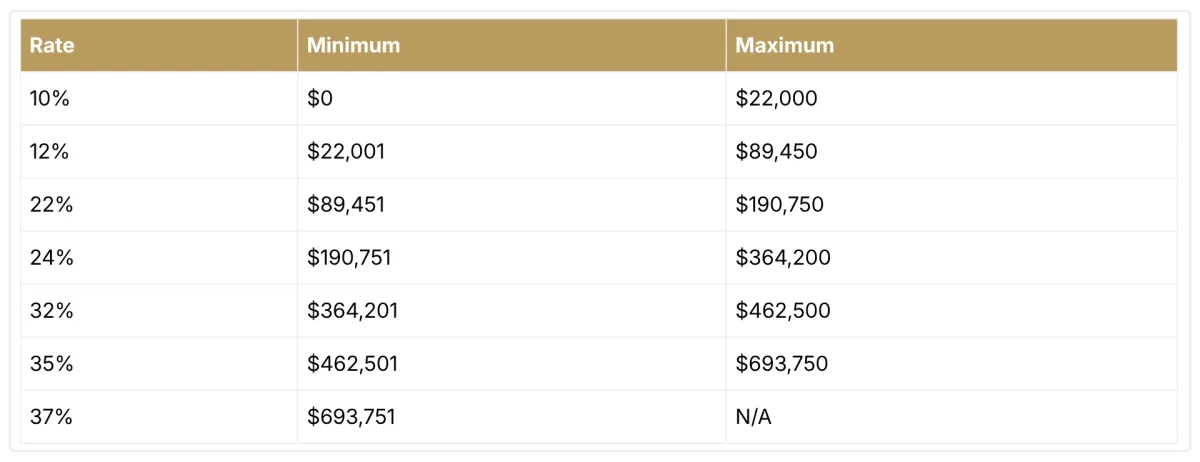
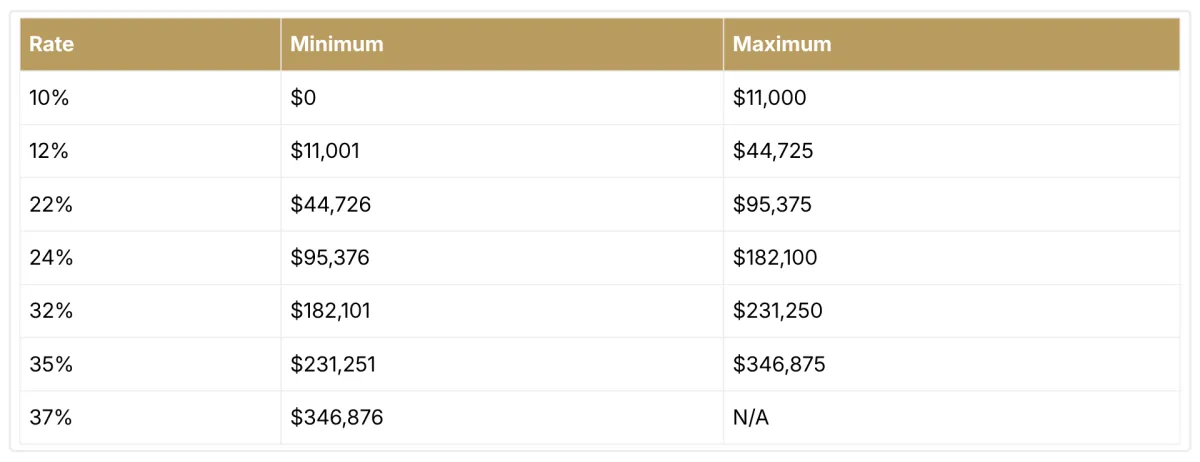
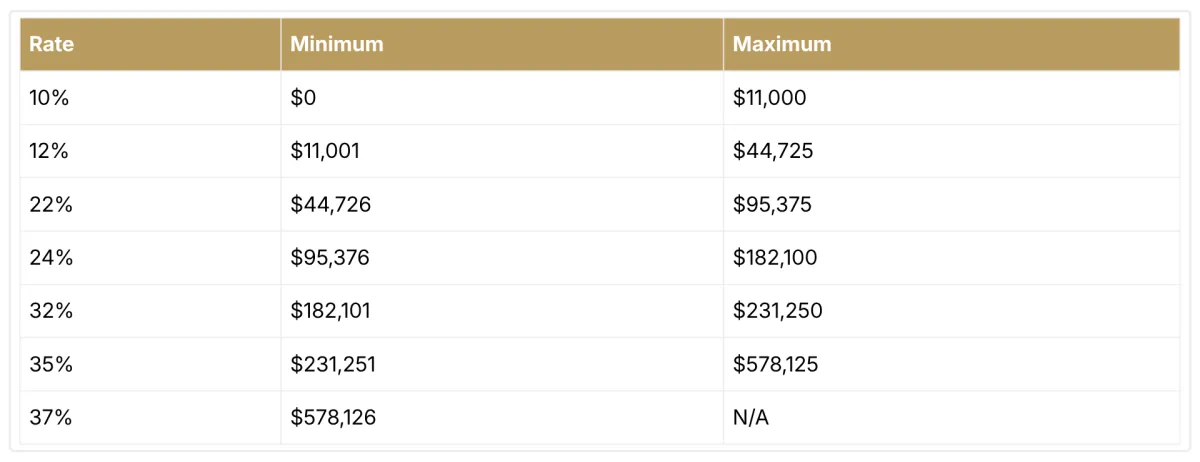
Please note: Tax rates are for the 2023 tax year and will be updated to the 2024 rates after the 2024 tax filing deadline.
Married Filing Jointly
Married Filing Separately
Single
Head of Household
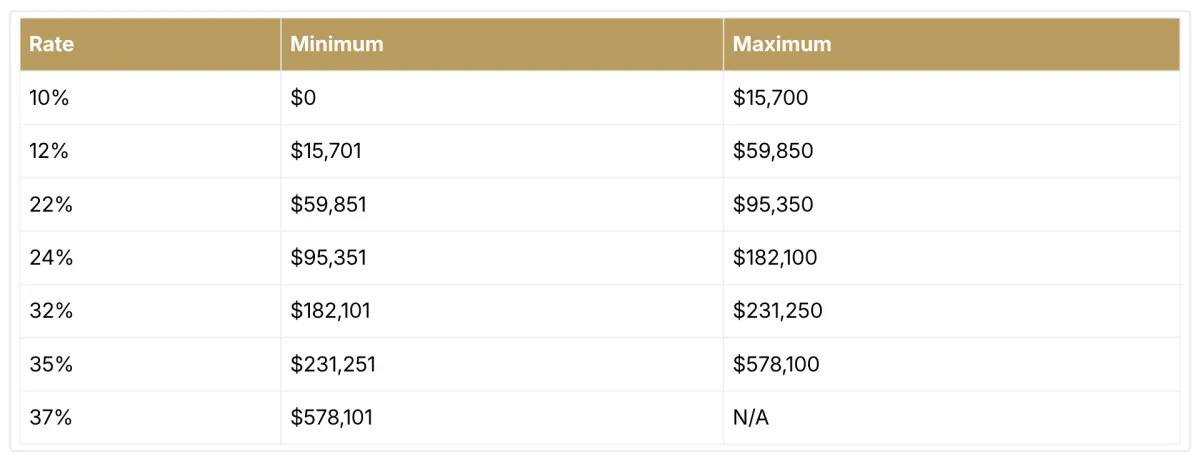
Source: IRS.gov, 2023.
This content is developed from sources believed to be providing accurate information. This table is for informational purposes only and is not a replacement for real-life advice. Make sure to consult your tax, legal, and accounting professionals before modifying your tax strategy.

Partner with a Process-Driven Firm
Let's discuss how Vann Equity's disciplined, data-driven investment approach can align with your financial objectives.


Sophisticated portfolio solutions for institutional and individual investors.
Contact Us
Phone Number
Email Address
Follow Us


Our Locations
Plano Office
4975 Preston Park Blvd., Suite 490
Plano, TX 75093

Austin Office
11824 Jollyville Rd., Suite 500
Austin, TX 78759

Partner with a Process-Driven Firm
Let's discuss how Vann Equity's disciplined, data-driven investment approach can align with your financial objectives.
Sophisticated portfolio solutions for institutional and individual investors.
Contact Us
Phone Number

Email Address

Follow Us


Our Locations
Plano Office

4975 Preston Park Blvd., Suite 490 Plano, TX 75093

Austin Office
11824 Jollyville Rd., Suite 500
Austin, TX 78759